Entraña: Where It Really Is, and Why It Is Not Fraldinha
Entraña is the diaphragm, inside the rib cage. Fraldinha is the belly wall. See where each one really is on a cut map, how to tell them apart and how to grill entraña.
Entraña is the diaphragm of the steer: the thin sheet of muscle that separates the chest from the belly and moves every time the animal breathes. It is attached to the inside of the rib cage, which is why you never see it on the outside of a butcher chart. It is the cut Argentines put on the grill first at an asado, and in English it is sold as outside skirt steak.
It is not fraldinha. Fraldinha comes from the wall of the belly, behind the ribs and below the alcatra. The two cuts are neighbors, look alike on the counter and are cooked the same way, which is where the confusion comes from. But they are different muscles, from different places, and they eat differently.
Also known as: Entranha or diafragma (Brazil), outside skirt (US, IMPS 121C), skirt steak (UK and US), hampe (France), arrachera (Mexico, where the name also covers inside skirt).
Where entraña really is
On the map below, the red band is the entraña and the gold block is the fraldinha. The chart is the side view Brazilian butchers use, with the Brazilian names. The diaphragm does not show on any outside view, so the red band marks where it sits inside the body: a dome that starts at the spine, just behind the alcatra, and runs down along the inside of the last ribs to the breastbone, behind the costela and the ponta de agulha.
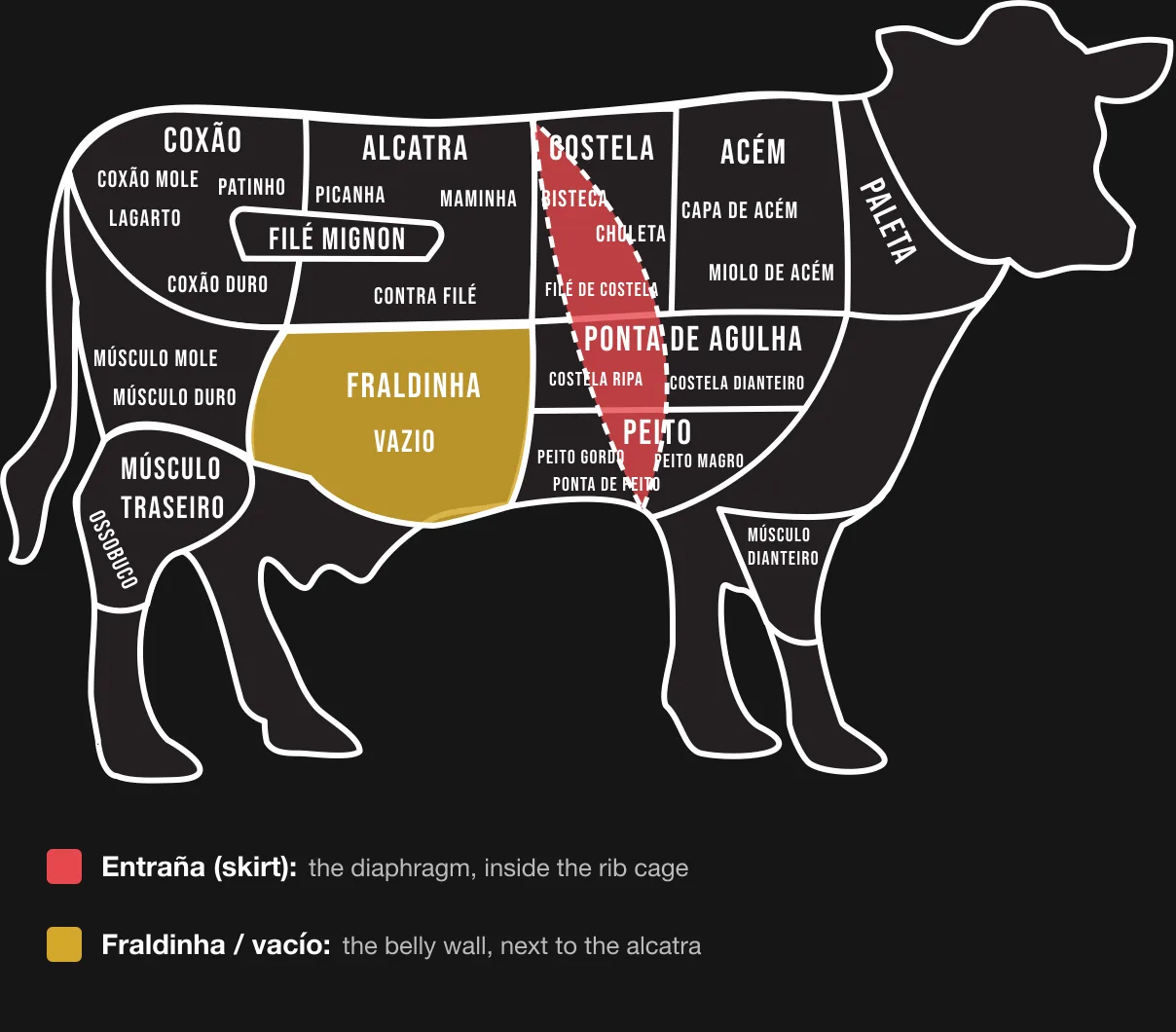
The fraldinha (gold) is on the other side of that line: outside the rib cage, in the belly, between the alcatra and the hind leg. Brazilians in the south call that area vazio, Argentines and Uruguayans call it vacío, and that is exactly where fraldinha comes from.
So why do so many people put entraña in the same place? Because most charts print it there. Argentine charts usually write ENTRAÑA inside the vacío block, next to matambre, because a flat side view has no way to show a muscle that sits inside the chest. It is a drawing shortcut, not anatomy. The cut that comes out of the rib cage is entraña. The cut that comes out of the belly wall is fraldinha.
Entraña vs fraldinha
| Entraña | Fraldinha | |
|---|---|---|
| Muscle | Diaphragm, rib part | Belly wall (internal oblique) |
| Where | Inside the last ribs | Below the alcatra, outside the ribs |
| Shape | Long, narrow ribbon | Wide, flat rectangle |
| Grain | Fibers run across the width | Fibers run along the length |
| Covering | Shiny membrane on both sides | Little or no membrane |
| Per animal | Two, about 0.5 to 1 kg each | Two, about 1 to 1.5 kg each |
| Flavor | Deep, rich, almost mineral | Beefy, juicy, milder |
How to tell them apart on the counter
- Look at the shape. Entraña is a long, narrow ribbon, often 50 cm or more, and only a few centimeters thick. Fraldinha is a wide, flat piece, thicker at one end.
- Look at the grain. On entraña the fibers run across the ribbon, from one long edge to the other. On fraldinha they run along the piece. This is the quickest test.
- Look for the membrane. Whole entraña comes wrapped in a thin, shiny membrane. Fraldinha has little or none.
- Look at the color. Entraña is usually a darker red, because a muscle that works all day carries more of the protein that colors meat.
The other cuts called entraña
Two more cuts get mixed up with entraña, and names change from one butcher to the next:
- Inside skirt (IMPS 121D) is a different, thinner muscle from the flank. It is often sold as skirt, and in some places as entraña, but it is not the diaphragm.
- Hanger steak (onglet) is the thick piece of the diaphragm that holds it to the spine. Some butchers call it entraña gruesa. See our hanger steak guide.
If the label matters to you, ask the butcher which muscle it is, or check the grain and the membrane yourself.
How to cook entraña
- Membrane on or off. In Argentina it is often grilled with the membrane on, which turns crisp and holds the juice in. If you prefer it off, peel it with your fingers and a thin knife before salting
- Salt only. Coarse salt just before it goes on the fire. A marinade is optional
- Very hot fire, short cook. 3 to 5 minutes per side over hot charcoal, depending on thickness. Pull at 52 to 54°C (126 to 129°F) for medium-rare
- Rest 3 to 5 minutes
- Cut it in two steps. First cut the ribbon into pieces about a hand wide. Then turn each piece and slice it thin across the fibers. Because the grain runs across the ribbon, slicing straight down the length is cutting with the grain, and that is what makes it chewy
Frequently asked
Is entraña the same as fraldinha?
No. Entraña is the diaphragm, attached to the inside of the rib cage. Fraldinha is part of the belly wall, below the alcatra, in the area the Argentines call vacío. They are neighbors and are grilled the same way, but they are different muscles.
What is entraña in English?
Outside skirt steak. In shops it is often just called skirt steak. Hanger steak and inside skirt are different cuts that are sometimes sold under the same names.
Is entraña offal?
It is muscle, not an organ. Because it sits inside the body cavity, some butchers sell it next to the offal, and some countries classify it that way, but it eats like a steak.
Why is entraña so tender if the muscle never stops working?
The fibers are coarse, but the cut is thin and the fibers are short across the ribbon. Cooked fast to medium-rare and sliced across the grain, it is tender and very juicy. Overcooked, it turns tough quickly.
How does MeatGrader score entraña?
MeatGrader reads a photo of the cut for marbling, color, texture and fat and returns its own 0-100 score with a tier from Supreme to Standard. On entraña it looks at the marbling between the fibers, the color of the lean and the condition of the surface. Photograph it with the membrane peeled back if you can, so the meat is visible.
Before you buy
Two pieces of entraña on the same counter can be very different. If you want a second opinion before you pay, take a photo with MeatGrader and compare the scores. You get 3 free grades to start.